

Rainbow Celery Science: Absorption Adventure!
Description: In this fun and colorful experiment, you will explore how plants absorb water and demonstrate the phenomenon using celery stalks. By adding food coloring to water, you will witness how plants can transport and distribute water throughout their structures, creating a vibrant rainbow effect in the celery stalks!
Scientific Principles:
- Plant Anatomy: Understand the structure of plants, including their vascular system responsible for water transport.
- Capillary Action: Learn about capillary action and how it helps water move through narrow spaces, such as the xylem vessels in plants.
- Absorption: Observe how plants absorb water and distribute it to different parts of their bodies, including leaves and stems.
- Transpiration: Explore the process of transpiration, where water is evaporated from the leaves, helping to pull more water up through the plant.

Equipment Needed:
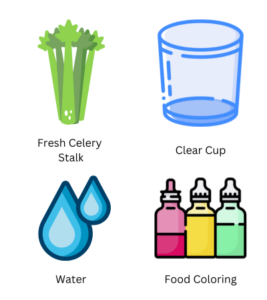
- Fresh celery stalks (with leaves intact)
- Clear cups or glasses
- Water
- Food coloring (various colors)
- Scissors
- Paper towels
- Plastic wrap or aluminum foil
- Optional: magnifying glass
Equipment Obtaining Difficulty: 2/5 (Items are common household items or easily available at grocery stores.)
Experiment Difficulty: 3/5 (May Require some adult supervision and some precision while handling the materials.)
Instructions
- Ask an adult for help in gathering the materials needed for the experiment.
- Set up your work area on a flat surface, such as a table or countertop.
- Place the clear cups or glasses in a row on the table. Make sure you have enough cups for each color of food coloring you want to use.
- Ask an adult if needed to fill each cup with water, stopping about two-thirds from the top. Leave enough room to fit a celery stalk inside without overflowing.
- Pick your favorite color of food coloring and ask an adult if needed to add a few drops of it into one of the cups. Remember to use a different color for each cup.
- Carefully stir the water in each cup with a spoon to mix the food coloring well. Observe how the water changes color.
- With an adult’s help if needed, use scissors to cut off the bottom of each celery stalk. The cut should be about 2 inches from the end. Be careful not to hurt yourself or damage the table.
- Take one of the celery stalks and place it in a cup with the colored water. The cut end should be submerged in the water while the leaves stick out above the rim of the cup. Repeat this step for the other celery stalks, using a different cup for each color.
- Cover each cup with plastic wrap or aluminum foil. This will help prevent the water from evaporating quickly.
- Leave the cups undisturbed in a safe place, like a kitchen counter or a windowsill where they won’t be knocked over. You can also make a note of the starting time so you can track how long the experiment takes.
- Wait patiently for several hours or overnight. During this time, the celery stalks will start absorbing water and the colors will begin to show in the leaves.
- After the waiting period, carefully remove the celery stalks from the cups. Hold them above the cups for a moment to let any excess water drip off.
- Place the celery stalks on a few paper towels to dry. Arrange them in a row so you can compare the colors easily.
- Take a close look at the celery stalks and observe the changes in color. Use a magnifying glass if you have one to examine the patterns more closely. Notice how the colors spread through the stalks and into the leaves.
- Once you have finished observing and exploring, you can dispose of the used cups and clean up your work area.
Note: Adult supervision is recommended when handling scissors and using food coloring.
Simple Explanation:
When we place the celery stalks in the colored water, they start to drink the water up through tiny tubes inside called xylem. It’s like the celery is using a straw to drink! As the water moves up, it carries the color from the food dye, and that’s why the celery changes color. It’s like the plant is sipping on a tasty and colorful drink!

Detailed Explanation:
The celery stalk is like a tower with lots of tiny elevator shafts, known as xylem vessels. These “elevator shafts” allow water to move up from the bottom to the top.
Now, let’s say you put the celery into a glass of colored water. Two neat things start happening:
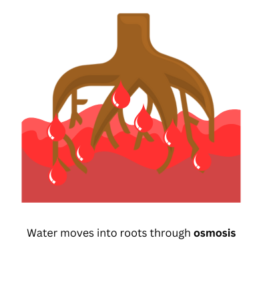
- Osmosis: This is like a thirst-quenching magic trick. The bottom of the celery is thirsty because it has less water than the colored water in the glass. So, it starts “drinking” up the water, similar to how a sponge soaks up water from a puddle. This process is called osmosis, where water moves from where there’s a lot of it (the glass) to where there’s less of it (inside the celery).
- Capillary Action: Once the celery has started drinking the colored water, capillary action takes over. This is like the magic power that helps water climb up against gravity. It’s how the water travels up the “elevator shafts” or xylem vessels in the celery. It’s a bit like when you dip a corner of a paper towel into some water, and the water spreads upwards, even if you didn’t dip the whole towel in.
Thanks to these two processes, osmosis and capillary action, after a while, you’ll see the color travel up and even reach the celery’s leaves. This cool experiment shows us how plants in nature “drink” water and send it all the way up to their tips!