
The Great Drop-A-Thon: Engineering Marvels for a Safe Landing!
Description:
Get ready for an egg-citing challenge! In this experiment, you’ll design and build a contraption to protect an egg from cracking when it’s dropped from a height. Put your engineering skills to the test as you learn about gravity, forces, and materials. Can you create a device that will keep your egg safe and intact?
Scientific Principles:
- Gravity and Forces: This experiment will explore the force of gravity and how it affects objects when they fall. You’ll learn about forces acting on the egg during the drop and how different materials can absorb and distribute these forces.
- Energy Transfer: The experiment will demonstrate how energy is transferred during the fall and how materials can absorb or dissipate this energy to protect the egg.
Materials Needed:
- Eggs (raw or boiled)
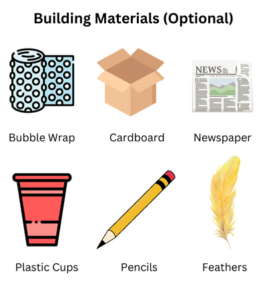
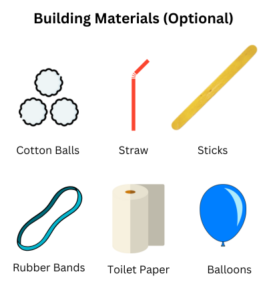
- Assorted materials for building (such as straws, popsicle sticks, cotton balls, rubber bands, tissue paper, balloons, bubble wrap, etc.)
- Tape
- Scissors
- String
- Measuring tape or ruler
- Optional: cardboard, foam, newspaper, plastic cups, feathers, etc.
Equipment Difficulty Rating:
Obtaining the equipment: 3/5 (Some materials may require adult assistance or may need to be purchased, but many can be found at home or in school.)
Completing the experiment: 4/5 (It requires some creativity and problem-solving skills, but it’s a fun challenge.)
Example 1: Straw and Balloon Cage
Materials needed:
- Straws
- Balloons
- Tape
Steps:
- Take two long straws and tape them together at one end to form an upside-down “V” shape.
- Attach two more straws horizontally across the top of the “V” shape, creating a square frame.
- Inflate a balloon and tie the end to keep the air inside.
- Place the inflated balloon inside the square frame, ensuring it is secure.
- Carefully place the egg on top of the balloon inside the cage.
- Gently wrap the balloon’s excess tied end around the straws to keep the egg and balloon in place.
- Make sure the egg is well-protected within the cage.
Example 2: Cotton Ball and Tissue Paper Cage
Materials needed:
- Cotton balls
- Tissue paper
- Tape
Steps:
- Take a handful of cotton balls and shape them into a soft, protective nest.
- Wrap the cotton ball nest with tissue paper, securing it with tape to keep it intact.
- Place the egg inside the cotton ball nest.
- Use additional tissue paper to create a cushioning layer around the egg, ensuring it is well-protected.
- Tape the tissue paper in place, creating a protective cage around the egg.
- Ensure that the egg is snug and secure within the cotton ball and tissue paper cage.
Other Methods for the Egg Drop Challenge:
- Parachute Method: Design and attach a parachute to your egg contraption using a plastic bag or lightweight fabric. The parachute will slow down the descent of the egg, reducing the impact upon landing.
- Cup Cradle Method: Create a cradle using plastic cups or cups cut from foam or cardboard. Nestle the egg in the cups, providing a cushioned landing surface.
- Straw Tower Method: Build a tower using straws and tape, with the egg enclosed within a protective structure at the top. The tower’s height and structural design will help absorb the impact upon landing.
- Feather Pillow Method: Construct a soft pillow using feathers, foam, or soft materials to cushion the egg within a container. The pillow will absorb the impact and protect the egg during the drop.
The Egg Drop Challenge is open-ended, allowing for limitless creativity and experimentation! Make sure to explore different materials, designs, and methods to find the best protection for the egg!
Simple Explanation:
During the Egg Drop Challenge, we design special cages to protect our eggs when they’re dropped. The cages have different materials that can absorb and spread out the force of the fall. When the egg is inside the cage, these materials act like a cushion, making the landing softer. It’s like wearing a helmet when riding a bike to protect your head from bumps. Our goal is to find the best cage design that keeps the egg safe and prevents it from cracking when it hits the ground!
Detailed Explanation:
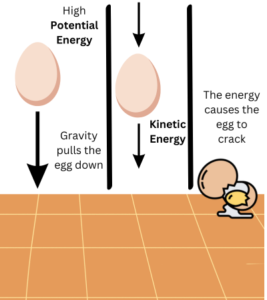
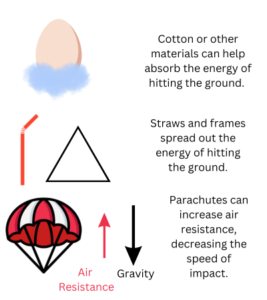
In the Egg Drop Challenge, we’re exploring the scientific principles of force and energy transfer. When the egg is dropped, gravity pulls it towards the ground, and it gains potential energy as it falls. As it hits the ground, this potential energy is converted into kinetic energy, which can potentially crack the egg.
To protect the egg, we create different cage designs using various materials. These materials help absorb and distribute the energy from the fall. For example, using soft materials like cotton balls or foam can absorb the energy by compressing and spreading out the force over a larger area. Alternatively, constructing structures with straws or frames can distribute the energy by transferring it along the structure, keeping the egg from experiencing a sudden impact.
By experimenting with different cage designs and materials, we’re investigating how forces are managed and distributed during the fall, aiming to minimize the impact energy on the egg. This challenge encourages us to think like engineers, considering the properties of materials, force absorption, and energy transfer, to successfully protect the egg from cracking upon landing.