
Catapult Craze: Launching Fun with Science!
Description: In this exciting experiment, you will learn how to build a catapult using simple materials. Get ready to explore the principles of force, motion, and energy as you launch small objects through the air. It’s time to unleash your inner engineer and have a blast with physics!
Scientific Principles:
- Force and Motion: You will discover how force can be applied to an object to make it move and how motion can be influenced by different factors.
- Potential and Kinetic Energy: You will learn about the transfer of energy from potential to kinetic as you release the catapult arm.
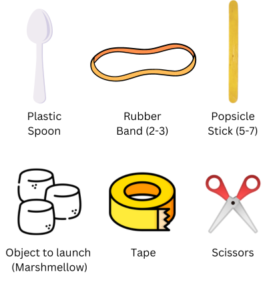
Equipment Needed:
- Plastic spoon
- Popsicle sticks (5-7)
- Rubber bands (2-3)
- Small object to launch (marshmallow, small ball, or cotton ball)
- Tape
- Scissors
Difficulty Ratings: Equipment: ★★★☆☆ (3/5) Experiment: ★★☆☆☆ (2/5)
Safety Tip: Make sure to ask an adult for help when using scissors.
Step 1: Get ready! Gather all the materials listed above. Find a clear and open space to conduct your experiment, such as a table or a wide-open floor area.
Step 2: Build the catapult base. a) Take two popsicle sticks and tape them together at one end, creating an “X” shape. The taped end will be the center point of your catapult. b) Repeat the previous step with two more popsicle sticks to make another “X” shape. c) Stack the two “X” shapes on top of each other, with the taped ends in the middle. Use tape to secure them together at the center.
Step 3: Add the base support. a) Take the remaining popsicle stick and tape it to the bottom of the stacked “X” shapes. This will serve as the base support for your catapult.
Step 4: Prepare the launching arm. a) Hold the plastic spoon with the scoop facing up. b) Attach two rubber bands around the handle of the spoon, one near the base and the other near the scoop. Make sure they are secure but not too tight.
Step 5: Connect the launching arm to the base. a) Position the spoon on top of the stacked popsicle sticks, with the handle pointing away from the base. b) Take one rubber band and stretch it from the base of the catapult to one end of the top popsicle stick. Hook it around the stick to hold it in place. c) Repeat the previous step with another rubber band, stretching it from the base to the other end of the top popsicle stick.
Step 6: Load and launch! a) Take your small object (marshmallow, small ball, or cotton ball) and place it on the spoon’s scoop. b) Gently pull back on the spoon, stretching the rubber bands. c) Aim the catapult at your desired target. d) Release the spoon, and watch as your object launches through the air!
Safety Tip: Remember to launch your objects in a safe and clear area, away from fragile objects and other people.
Step 7: Observe and experiment! Try launching different objects and adjusting the tension of the rubber bands. See how far and how high you can make your objects fly. Record your observations and findings in your science journal.
Remember, always have fun and enjoy exploring the world of catapults with your homemade creation!
Simple Explanation:
When you pull back the spoon on the catapult, you’re storing energy in the rubber bands. When you let go of the spoon, the stored energy is released, making the spoon and the small object attached to it move really fast. The fast movement gives the object enough force to fly through the air!
Detailed Explanation:
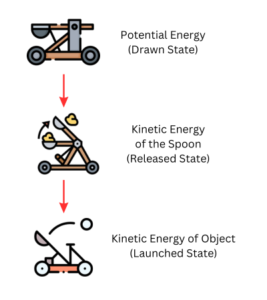
The catapult experiment involves the principles of potential energy, kinetic energy, and force. When you pull back the spoon on the catapult, you’re stretching the rubber bands and storing potential energy in them. Potential energy is like stored energy waiting to be released.
When you let go of the spoon, the potential energy in the stretched rubber bands gets converted into kinetic energy. Kinetic energy is the energy of an object in motion. As the rubber bands snap back to their original shape, they push the spoon forward with a lot of force. This force is what propels the small object off the spoon and into the air.
The faster the spoon moves, the more kinetic energy it has. This energy is then transferred to the small object, causing it to launch through the air. The distance and height the object travels depend on factors like the tension of the rubber bands and the angle at which the catapult is aimed.
By experimenting with different variables, you can learn more about the relationship between force, energy, and motion.