
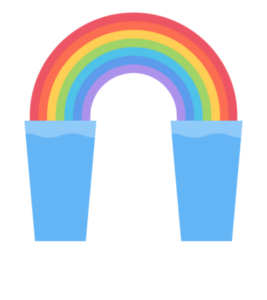
Walking Water Rainbow
Description: Are you ready to make magic at home with colors and water? We’re going to create a beautiful rainbow that seems to “walk” by itself! We’ll see how water can move from one cup to another, even if there’s no slope or force. This fun experiment helps you understand some cool science concepts, like capillary action and color mixing!
Scientific Principles:
- Capillary Action: This is how water can move uphill or against gravity. It’s the same principle that helps plants and trees get water from the ground up into their leaves. When we place our paper towels into the cups, they act like mini capillary tubes!
- Color Mixing: By mixing the primary colors (red, blue, and yellow), we can make secondary colors (purple, green, and orange). You’ll see this happening in front of your eyes as the “walking” water mixes the colors together.
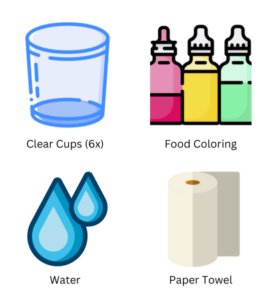
Materials Needed:
- 6 Transparent cups (glass or plastic)
- Paper towels (about 6 sheets)
- Food coloring (red, blue, and yellow)
- Water
Equipment Difficulty Rating: 1 (These items are commonly found at home or easy to get at your local store)
Experiment Difficulty Rating: 2 (The experiment steps are easy, but need a bit of patience as we wait for the water to “walk”)
What the Experiment is About:
In this experiment, you’re going to set up six cups in a circle and fill every other cup with colored water. Then, you’ll place paper towel bridges between each cup. After a while, you’ll see the colored water “walk” along the paper towels and start to fill the empty cups. As the different colored waters meet, they will mix together to form new colors. By the end of the experiment, instead of empty cups, you will have a full circle of cups showing off a beautiful, self-made rainbow!
Alright, it’s time for our Amazing Rainbow Walking Water Experiment! Let’s make a rainbow!
**Step 1: Gather Your Materials**
First, you need to gather everything you need. Find 6 transparent cups, some paper towels, food coloring in red, blue, and yellow, and water.
**Step 2: Set Up Your Cups**
Arrange your 6 cups in a circle on a flat table or countertop. Make sure there’s no slope; we want them all at the same height.
**Step 3: Add Water and Color**
Pour water into the 1st, 3rd, and 5th cup until they are about three-quarters full. Leave the 2nd, 4th, and 6th cup empty for now. Now, let’s add color! Add about 5 drops of food coloring to each of the cups with water. Put red coloring in the 1st cup, yellow coloring in the 3rd cup, and blue coloring in the 5th cup. Stir gently with a spoon if needed, until the color is mixed well.
**Step 4: Create Your Paper Towel Bridges**
Take your paper towels and fold them lengthwise until they are about an inch wide. These will act like bridges between your cups. You need to make them long enough to reach from one cup into the next one with a little bit hanging over each side. You should have 6 paper towel “bridges”.
**Step 5: Place Your Paper Towel Bridges**
Now, carefully place one end of a paper towel into the 1st cup (with red water), and the other end into the 2nd cup (which is empty). Do the same between all the cups, making sure there’s a paper towel connecting each pair of neighboring cups. The last paper towel should connect the 6th and 1st cups.
**Step 6: Watch the Magic Happen**
Now, all you have to do is wait and watch. You’ll start to see the water climb up the paper towel out of the cups with water, and “walk” down into the empty cups. Be patient, this might take a few hours. The longer you wait, the more water will transfer, and the more color mixing will happen.
**Step 7: Observe and Learn**
After a few hours or the next day, come back to see what happened! Each of your empty cups should now have water in them. Look at the new colors created. Can you see where the red and yellow water mixed to make orange, or where the blue and yellow made green, and the red and blue made purple?
Congratulations! You just made your very own walking water rainbow! You are a scientist!
Simple Explanation:
Have you ever seen a sponge suck up water? Or how a tree gets water from the ground up to its leaves? It’s kind of like they’re drinking through a straw! In our experiment, the paper towels are doing something similar. They’re helping the colored water move from one cup to another, even if there’s no slope. It’s like they’re sipping up the water and then dropping it into the next cup. This is called capillary action. Also, as the water walks from one cup to another, it carries the color with it and mixes with the color in the next cup, and that’s how we get new colors!
Detailed Explanation:
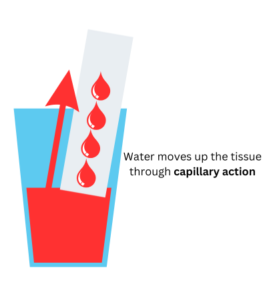
This experiment demonstrates a process known as capillary action. Capillary action is the ability of a liquid to flow in narrow spaces without the assistance of, or even in opposition to, external forces like gravity. It happens because water is sticky and likes to stick to other materials – a property called adhesion. Water also likes to stick to itself – a property called cohesion. When you put the paper towel into the water, the water sticks to it and then gets pulled up into the tiny spaces between the fibers of the paper towel. This is due to the adhesive force between the water and the paper towel being stronger than the cohesive forces inside the water itself.
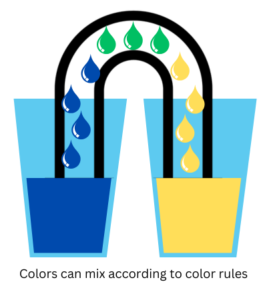
This experiment also illustrates the principle of color mixing. As the water ‘walks’ across the paper towel from one cup to another, it carries the food coloring with it. When the colored water from two different cups meets in an initially empty cup, the colors mix to form a secondary color. For example, when the blue and yellow water meet, they combine to create green, demonstrating that secondary colors are made by mixing two primary colors.