

Zooming Balloon Rockets: Blast Off into Science!
Description: In this exciting experiment, we will explore the principles of propulsion and motion by creating our very own balloon rocket! Get ready to witness a mini rocket launch right in your living room and learn about the science behind it.
Scientific Principles:
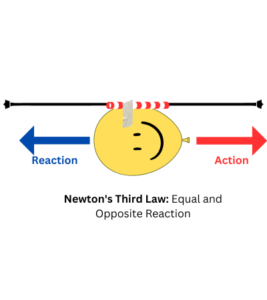
- Newton’s Third Law of Motion: Every action has an equal and opposite reaction.
- Propulsion: The force that propels an object forward.
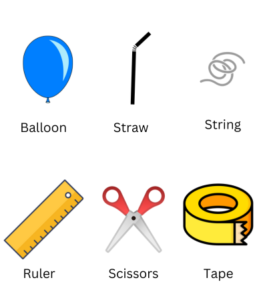
Equipment Needed:
- Balloon
- Drinking straw
- String
- Tape
- Scissors
- Markers (optional)
- Measuring tape or ruler
Equipment Difficulty Rating: Obtaining the equipment is relatively easy and can be found at home or easily purchased at a nearby store. Rating: 1/5
Experiment Difficulty Rating: Rating: ⅗
Instructions:
Step 1: Prepare the Launching Area
- Find a suitable launching area, like a long hallway or a spacious room.
- If you’re indoors, make sure there are no fragile objects or obstacles in the way.
- If you’re outdoors, find an open space away from trees or anything that could obstruct the path of the balloon rocket.
Step 2: Set Up the Clothesline
- Take the string and cut a piece that is around 3-4 feet long. If you’re not sure about the length, ask an adult to help you measure it using a measuring tape or ruler.
- Take one end of the string and tie it securely to one point in the launching area.
- Take the other end of the string and tie it securely to another point in the launching area. The string should be taut like a clothesline.
Step 3: Prepare the Balloon Rocket
- Inflate the balloon by blowing air into it through the opening.
- Pinch the end of the balloon to prevent the air from escaping.
Step 4: Attach the Balloon to the Straw
- Take the drinking straw and hold it horizontally.
- Place the inflated balloon over the end of the straw, but don’t let go of the pinched end.
- Use tape to secure the balloon to the straw. Make sure it’s firmly attached but not covering the open end of the straw.
Step 5: Position the Balloon Rocket
- Hold the straw with the attached balloon parallel to the string.
- Place the straw on the string so that the balloon end is facing towards the open end of the string. The balloon should be pointing away from you.
Step 6: Launch the Balloon Rocket
- Make sure the string is taut and not sagging.
- Let go of the balloon and watch it zoom along the string!
- Observe how far it travels and how fast it goes.
Step 7: Experiment and Observe
- Try launching the balloon rocket multiple times.
Fun Tips:
- You can decorate your balloon rocket with markers to make the rocket even more fun!
- Measure the distance traveled by the balloon rocket using a measuring tape or ruler to compare different launches.
Safety Precautions:
- Be careful not to aim the balloon rocket at people or fragile objects.
- Adult supervision is recommended, especially when handling scissors and using tape.
Now, get ready to have a blast with your very own balloon rocket and discover the exciting science behind it!
Simple Explanation:
When we inflate the balloon and let the air out, it creates a force that pushes the balloon forward. This force is called propulsion. The air pushes backward against the balloon, and according to Newton’s Third Law of Motion, there is an equal and opposite reaction. This reaction force makes the balloon rocket zoom forward along the string. It’s like a mini rocket launch!
Detailed Explanation:
The balloon rocket experiment demonstrates the principles of propulsion and motion. When we inflate the balloon, it fills up with air molecules. When we let go of the balloon, the air molecules inside it start to rush out in all directions. But because the opening of the balloon is taped to the straw, the air molecules can only escape in one direction, which is backward.
According to Newton’s Third Law of Motion, for every action, there is an equal and opposite reaction. So, when the air molecules rush backward out of the balloon, they push the balloon rocket forward with an equal force. This force propels the balloon rocket along the string. The longer and more forceful the rush of air, the faster and farther the balloon rocket will travel. It’s an exciting way to see Newton’s laws in action!