

Float Your Boat – The Tin Foil Boat
All aboard! Welcome to the Tin Foil Boat Challenge. In this experiment, we will transform ordinary kitchen foil into extraordinary miniature boats. Your mission? Find out how much cargo these boats can carry before they surrender to the waves. You’ll discover the secrets of floating, the power of buoyancy, and the puzzling principles of density.
Scientific Principles:
-
Buoyancy: It’s the force that helps things float in a fluid, like our boats in water. Even though the boats and their cargo are heavy, they can still float because of buoyancy.
-
Density: Density is how much ‘stuff’ (mass) you can pack into a certain amount of space (volume). If your boat is less dense than the water, it floats. If it’s denser, it sinks.
-
Archimedes’ Principle: This law states that the upward buoyant force on an object in a fluid is equal to the weight of the fluid displaced by the object.
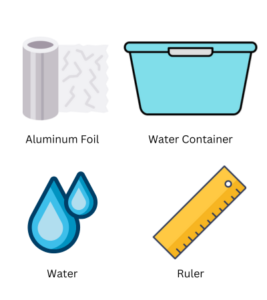
Equipment Needed:
-
Aluminum Foil
-
A large bowl or a sink
-
Tap water
-
Ruler or measuring tape (optional)
-
Weights (pennies, marbles, paper clips, LEGO pieces, small pebbles, beads, erasers, rice grains, buttons, small toy figures, crayons)
Equipment Difficulty Rating: 1
You will find all these items in most homes, so they are very easy to collect.
Experiment Difficulty Rating: 2
The experiment is straightforward but requires some skill in crafting the boat and adding weights without tipping it over.
Step-by-Step Instructions:
Step 1: Gather Your Materials First, we need to collect all the things we’ll use for our experiment. Here’s your list:
-
Aluminum Foil
-
A large bowl or use your kitchen sink
-
Tap water
-
Pennies, marbles, paper clips, LEGO pieces, small pebbles, beads, erasers, rice grains, buttons, small toy figures, crayons. These will be your boat’s cargo!
Step 2: Prepare Your Workspace Find a spot where you don’t mind getting a bit wet, like the kitchen table or counter. Make sure it’s okay with your parents. Fill your large bowl or sink with water.
Step 3: Craft Your Boat Now, the fun part! Cut a piece of aluminum foil about as big as a regular piece of paper (you know, the one you draw on!). Now fold the foil into the shape of a boat. You can make it a simple rectangle boat or a fancy pirate ship! Just make sure it looks like a boat and has room to carry your cargo.
Step 4: Test Your Boat Time for the first test! Place your foil boat gently on the surface of the water in your bowl or sink. Does it float on the top like a duck in a pond? Awesome! If it sinks like a stone, that’s okay. Try again with a new piece of foil and a new boat design.
Step 5: Load the Cargo Start by adding one piece of cargo – let’s start with a penny – to your boat. Did it stay floating? Great! Add one more piece of cargo. Keep adding one piece at a time, counting each one.
Step 6: Keep Adding Until it Sinks Keep adding cargo to your boat, always one at a time. You might notice your boat getting lower and lower in the water, that’s okay. The goal is to see how much cargo your boat can carry before it sinks.
Step 7: Record Your Results How many pieces of cargo did your boat carry before it sank? Write down that number – that’s your result.
Step 8: Try, Try Again Now let’s get creative. Make another boat, maybe a different shape or size this time. Repeat steps 5-7 with your new boat. Did it hold more or less cargo than the first boat?
You’re not just making and sinking boats, you’re being a real scientist! You’re learning about how boats float, how adding weight can make them sink, and how different shapes and sizes can hold more or less weight. Plus, you’re having fun – and that’s the most important part of any experiment!
Simple Explanation:
Have you ever wondered how a heavy ship can float on water? It’s all because of something called “buoyancy.” When you put your boat in the water, it pushes some water out of the way. The water that gets pushed away wants to come back to its spot, so it pushes back up against your boat. This push is called buoyancy, and it helps your boat float! When we put more cargo on the boat, it gets heavier and pushes down more. If we put too much weight, the water can’t push up hard enough, and the boat sinks!


Detailed Explanation:
The floating and sinking of your aluminum boat is explained by two main scientific principles: buoyancy and density, governed by Archimedes’ principle.
Buoyancy is the upward force exerted by a fluid (in this case, water) that opposes the weight of an object immersed in it. When your boat is placed on water, it displaces some water. This displacement creates an upward force called buoyant force, which helps the boat float. The more water displaced, the greater the buoyant force.
This brings us to density. Density is the mass of an object divided by its volume. If an object is less dense than the fluid it’s placed in, it will float. When the boat is empty, it’s less dense than the water because the boat’s volume includes the air inside it, which is much lighter than water.
Adding cargo increases the boat’s mass, but not its volume, making it denser. As the density of the boat approaches that of water, the buoyant force becomes less than the boat’s weight, and it begins to sink.
All this aligns with Archimedes’ principle, which states that the upward buoyant force exerted on a body immersed in a fluid is equal to the weight of the fluid that the body displaces. Once the weight of the boat (with its cargo) becomes greater than the weight of the displaced water, the boat can no longer float and thus, it sinks.